
 Tiếng Việt
 PRODUCT CATEGORIES
Of all the maintenance items on a motorcycle, brake fluid is probably the one riders forget most often. You remember to change the engine oil and check the tires, but that small reservoir bolted to the handlebar rarely gets a second look. The irony is that it’s tied directly to your safety every time you ride. This guide breaks down what motorcycle brake fluid actually is, what it does, the common types you’ll find, and how to know when it’s time for a change.
What is motorcycle brake fluid?
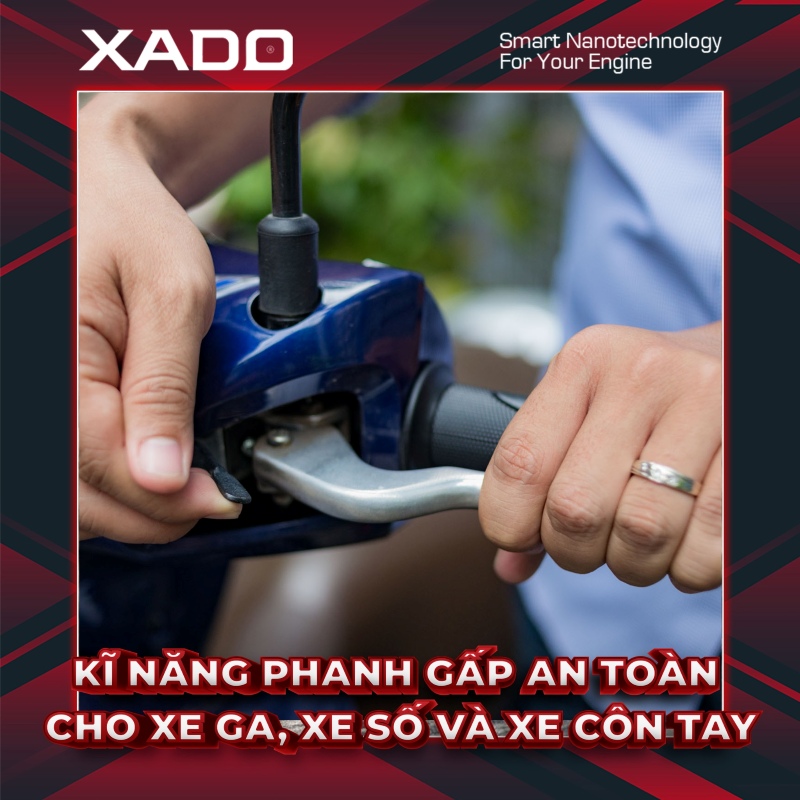
Motorcycle brake fluid is a specialized hydraulic fluid used in disc (hydraulic) brake systems. When you squeeze the brake lever or press the pedal, the fluid transfers that force from the master cylinder piston down to the caliper pistons, pushing the brake pads against the disc. That clamping action is what slows the wheel and brings the bike to a stop.
What makes brake fluid different from ordinary oil is its job description: it has to handle high temperatures, resist oxidation, stay virtually incompressible under heavy pressure, and avoid corroding the metal and rubber parts inside the system. Most fluids are glycol-based (DOT 3, DOT 4, and DOT 5.1) or silicone-based (DOT 5), and every one of them has to meet a strict technical standard built specifically for hydraulic braking.
What motorcycle brake fluid actually does
Brake fluid is more than a liquid that moves pressure around. It plays several roles at once.
First, it transmits hydraulic force from the lever to the pads instantly and precisely. Because the fluid is essentially incompressible, unlike air, which squashes easily, almost all of your hand pressure ends up as real braking force at the wheel.
Second, it lubricates the moving parts inside the master cylinder and caliper pistons, reducing friction and wear on the rubber seals and gaskets that keep everything sealed.
Third, it manages heat. Repeated braking creates enormous friction between pad and disc, and a lot of that heat passes into the fluid. A good brake fluid stays liquid under that stress instead of boiling and forming air bubbles that would rob you of braking power.
Finally, it protects against rust and corrosion on the internal metal components, which helps the whole brake assembly last longer.
The common types of brake fluid
Brake fluid is graded by the DOT standard (set by the U.S. Department of Transportation). Each grade has its own boiling point and chemistry, suited to different kinds of bikes.
DOT 3 is the everyday, glycol-based option, with a dry boiling point around 205°C and a wet boiling point near 140°C. It suits most commuter motorcycles and small-to-mid-displacement scooters running standard disc brakes.
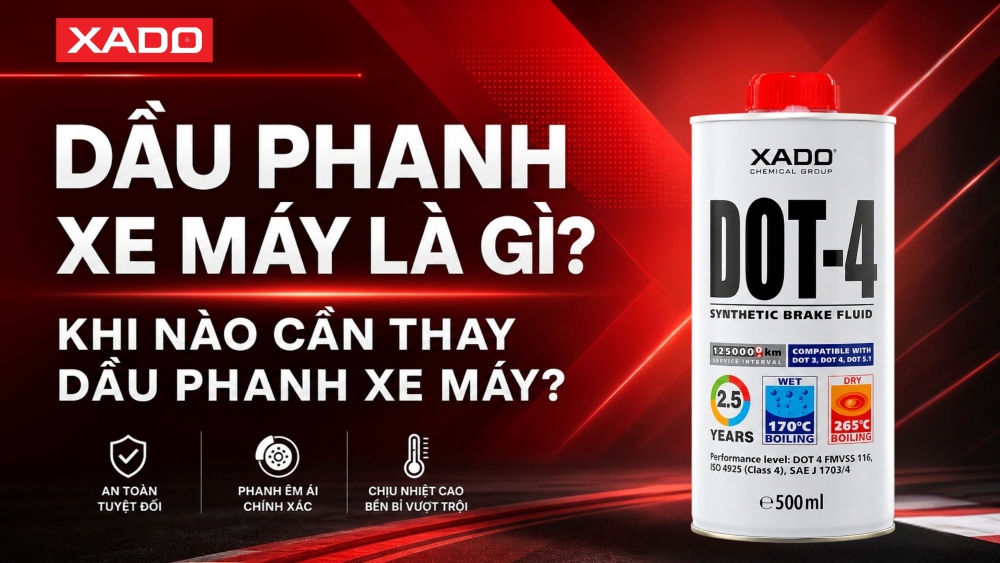
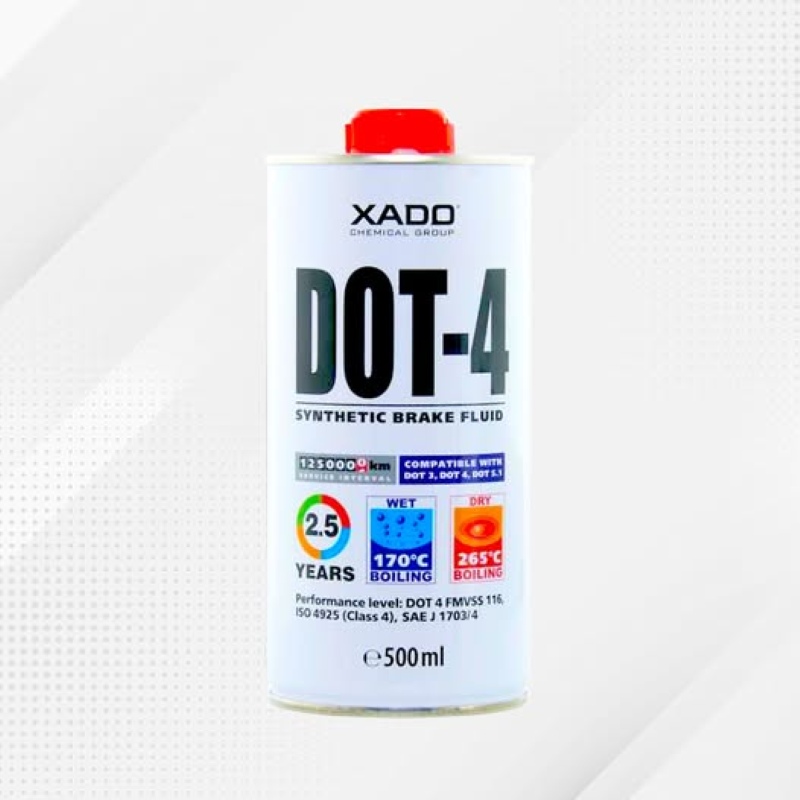
DOT 4 is also glycol-based but adds borate ester, which lifts the dry boiling point to roughly 230°C and the wet boiling point to about 155°C. It’s the recommended choice for larger scooters, manual-clutch bikes, and motorcycles ridden harder. XADO DOT-4 Brake Fluid is one product many riders rely on here, thanks to its consistent quality, high boiling point, and strong resistance to moisture absorption.
>> Learn more about XADO DOT-4 Brake Fluid
DOT 5.1 is still glycol-based but outperforms DOT 4, with a dry boiling point reaching up to 270°C. It’s typically used on big-displacement bikes, race machines, or anything ridden in demanding conditions.
DOT 5 is the odd one out. It’s silicone-based, doesn’t absorb water, and won’t damage paint. The catch is that it can’t be mixed with DOT 3, DOT 4, or DOT 5.1, and it’s rarely used on everyday motorcycles.
Important: DOT 3, DOT 4, and DOT 5.1 are compatible with one another, but never mix any of them with DOT 5 (silicone-based).
|
Fluid type |
Dry boiling point | Wet boiling point |
Chemical base |
|
DOT 3 |
~205°C | ~140°C |
Glycol ether |
|
DOT 4 |
~230°C | ~155°C |
Glycol ether |
|
DOT 5 |
~260°C | ~180°C |
Silicone |
|
DOT 5.1 |
~270°C | ~180°C |
Glycol ether |
A quick note on the numbers:
- Dry boiling point is the boiling point of fresh fluid that hasn’t absorbed any moisture.
- Wet boiling point is the boiling point after the fluid has taken on some moisture in real-world use. This is the figure that reflects true performance over time.
How to choose the right brake fluid for your motorcycle
Picking the correct fluid has a direct effect on how well your brakes work and how long they last.
Follow the Manufacturer’s Recommendation
The first and most important rule is to use what your bike’s manufacturer specifies. That information is usually printed right on the brake fluid reservoir cap or spelled out in the owner’s manual.
- For common commuter bikes and everyday scooters, DOT 3 or DOT 4 is generally the right fit.
- For bikes with ABS, large-displacement machines, or sport motorcycles, lean toward DOT 4 or DOT 5.1 for better heat resistance.
If you want a fluid that covers most commuter bikes and scooters, XADO DOT-4 Brake Fluid is worth a look. It’s a synthetic fluid that meets the international DOT 4 standard, with a high boiling point, solid oxidation resistance, and effective lubrication of the rubber and metal parts in the system. It’s also backward-compatible with DOT 3, so it works on bikes that call for DOT 3 as well — handy if you ride more than one machine.
Stick to reputable brands
Beyond the DOT rating, buy from trusted brands such as XADO, Castrol, Voltronic, or Motul, and purchase from authorized dealers to avoid counterfeit or low-grade fluid. Check the expiry date and make sure the bottle’s seal is intact before opening, because brake fluid absorbs moisture from the air very quickly once exposed.
Why you need to change brake fluid regularly
A lot of riders assume that because brake fluid sits in a sealed system, it never needs replacing. That’s a mistake. Glycol-based brake fluid is hygroscopic, meaning it gradually absorbs moisture from the surrounding air even through the rubber seals.
As the water content rises (often past 3% after one to two years of use), the fluid’s boiling point drops noticeably. At that point, hard braking on a long descent or in stop-and-go traffic can push temperatures high enough to boil the water in the fluid, creating air bubbles. Those bubbles compress easily, so the lever starts to feel spongy and weak, and in the worst case, you lose braking power entirely. This dangerous failure is called vapor lock.
Old fluid also tends to pick up contaminants: metal particles and rubber debris from worn seals. That can clog brake lines, seize pistons, and corrode the internal components of the caliper, shortening the life of the entire system.
When should you change motorcycle brake fluid?
As a general rule, most manufacturers recommend replacing brake fluid every two years or every 20,000–25,000 km, depending on how you ride. Beyond that schedule, change it right away if you notice any of these signs:
- The fluid has turned dark brown or black instead of the original pale, slightly translucent yellow. This is the clearest sign it has oxidized and picked up contaminants.
- The level in the reservoir has dropped below the MIN line, which can mean a leak in the lines or caliper, or simply that worn pads are forcing the pistons to extend further.
- The lever feels loose, with unusually long travel and no firm bite, or the brakes squeal, grab unevenly, or the bike drifts under hard braking.
- The brake warning light comes on (on bikes equipped with a sensor).
It’s also worth checking the fluid, bleeding the system, and topping up or replacing it whenever you fit new pads, rebuild a caliper, or replace a brake line.

Key tips when changing brake fluid
Changing brake fluid isn’t especially complicated, but it demands care, because this part is directly tied to your safety. Keep these points in mind.
Don’t mix different fluid bases
Never mix fluids with different chemical bases — especially glycol-based fluid (DOT 3, 4, 5.1) with silicone-based DOT 5. Doing so triggers a chemical reaction that can ruin the rubber seals and clog the system.
Keep brake fluid off your paint
When you pour, keep the fluid away from paint, plastic, and any rubber parts outside the brake system. Glycol-based brake fluid is highly corrosive and can strip paint. If it does spill, wipe it up immediately with a clean cloth and rinse the area with water.
Bleed the system after changing
During the change, bleed the brakes properly to remove every trace of air from the lines. Any air left in the fluid leaves the brakes spongy, weak and dangerous to ride on.
Store the fluid correctly
Reseal the bottle as soon as you’re done, and never reuse fluid you’ve already drained, since it has absorbed moisture and picked up contaminants.
When in doubt, use a trusted shop
Finally, if you don’t have the experience or the proper tools, take the bike to a reputable service center such as XADO’s Express Center network or an authorized brand workshop, so a technician can do the job to spec.
Brake fluid may be a small, rarely-mentioned detail, but it’s critical to keeping every ride safe. Understanding what it is, choosing the right type for your bike, and replacing it every two years or 20,000–25,000 km keeps your brakes consistent, extends the life of the system, and protects you on the road.
If you’re still unsure which one to choose, XADO DOT-4 Brake Fluid is a safe, high-quality option that fits most motorcycles on the road today. You can also browse the XADO guides for more on the products that keep your bike protected.
XADO VIETNAM
Address: 2nd Floor, VinFast Building – D1, 135–139 Dong Van Cong Street, Cat Lai Ward, Ho Chi Minh City
Website: www.xadovietnam.vn
Dealership inquiries: 028 77777 369
Email: kinhdoanh@songdailong.com



 About XADO