

 Tiếng Việt
 PRODUCT CATEGORIES
Choosing the right oil for your vehicle is one of the most important decisions you make as an owner. The right oil keeps your engine performing at its best and helps it last for years, while the wrong one can quietly wear it down.
But do you actually know what all those codes on the bottle mean? Most oil containers are covered in letters and numbers like API SN, JASO MA2, and SAE 10W-40, and they are not just marketing. Each one tells you something specific about the oil and whether it suits your engine.
In this guide, Xado Vietnam breaks down the three sets of motor oil grades you will see most often, so the next time you stand in front of a shelf full of bottles, you know exactly what you are looking at.
API service ratings
The API rating comes from the American Petroleum Institute, the body responsible for setting the standards that classify motor oil quality. Almost every major oil brand in the world uses the API system, which makes it one of the most reliable indicators of quality you can check.
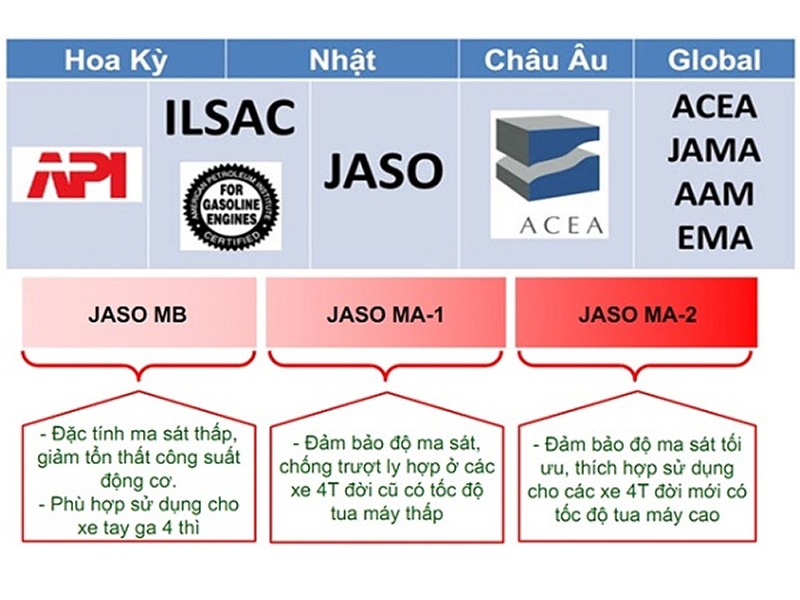
An API rating is written as two letters, and each one has a meaning:
- The first letter tells you the engine type the oil is made for. “S” stands for spark-ignition (gasoline) engines, and “C” stands for compression-ignition (diesel) engines.
- The second letter runs alphabetically and represents the quality level of the oil. The further along the alphabet it goes, the higher the quality.
For gasoline engines, API SN was introduced in October 2011 as a top-tier rating. Ratings like SM and SN were tested and optimized mainly for cars rather than motorcycles, so for motorcycle engines the more relevant high rating is SP.
Why does this matter? A higher API rating generally means the oil’s viscosity changes less as the temperature rises, and it does a better job of neutralizing the deposits and sludge that build up inside an engine. In short, a higher API grade usually means better lubrication and better protection.
Here is a simple way to picture it. Imagine an oil with a low API rating and a viscosity of 50. Once the engine heats up, that viscosity can drop all the way down to 10, leaving far less protection than the number on the bottle suggested.
JASO Standards
The JASO standard comes from the Japanese Automotive Standards Organization, and it is the system used widely across the Japanese oil industry. JASO focuses on the friction characteristics of the oil, which is especially important for motorcycles where the engine, clutch, and gearbox often share the same oil. The main categories are:
- JASO MA and JASO MA2: These ratings are intended for four-stroke motorcycles, including standard bikes and larger motorbikes. Oils that meet JASO MA and MA2 are designed to provide the right amount of friction for engines that use a wet clutch.
- JASO MB: This rating is intended for scooters. Automatic scooters have different friction requirements from manual four-stroke bikes, so oils built to JASO MB are formulated specifically for them.
- JASO FC and JASO FD: These ratings cover two-stroke engines, which have their own friction and lubrication needs that differ from four-stroke designs.
By matching the JASO rating to your type of vehicle, you make sure the oil behaves the way your engine and clutch expect, which protects performance and keeps the related components working smoothly.
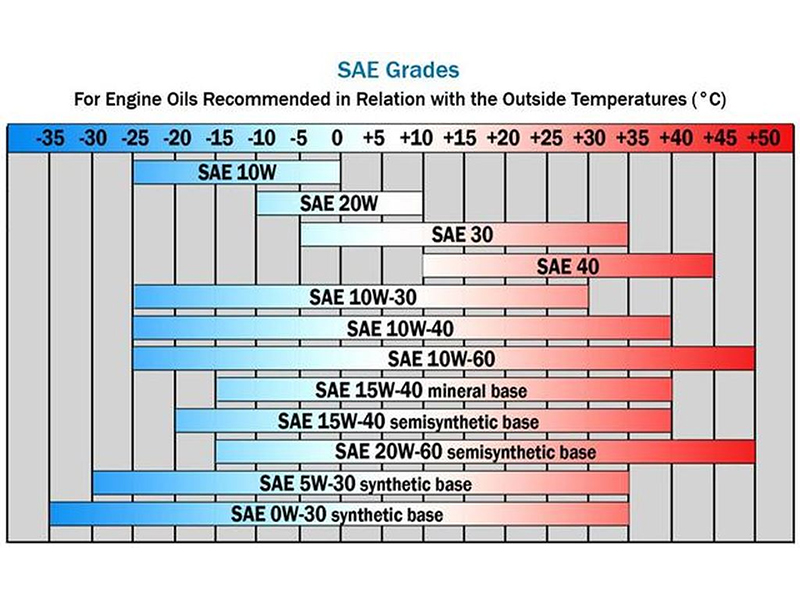
SAE viscosity grades
The SAE viscosity grade comes from the Society of Automotive Engineers, an international body that sets technical standards across the automotive industry. While API tells you about quality and JASO tells you about friction, the SAE number tells you about viscosity, which is how thick or thin the oil is at different temperatures.
The SAE system divides motor oil into two main types.
- Single-grade oil has one viscosity rating and suits a specific temperature range. SAE 40 and SAE 50 are common examples. The downside is that the viscosity of a single-grade oil changes a lot with the weather. It thins out when the engine is hot and thickens when it is cold.
- Multi-grade oil is built to hold a stable viscosity across a much wider temperature range. You can spot it by the “W” in the rating, as in SAE 10W-40. The “W” stands for Winter and refers to how the oil performs in the cold. With SAE 10W-40, the oil stays thin enough at low temperatures (the 10W part) for easy starting, and stable enough at high temperatures (the 40 part) to keep protecting the engine.
In practice, the SAE grade helps you match the oil to the climate you drive in. In colder regions, a multi-grade oil is the safer choice because it makes cold starts much easier. In consistently hot conditions, a single-grade oil can sometimes be a suitable option.
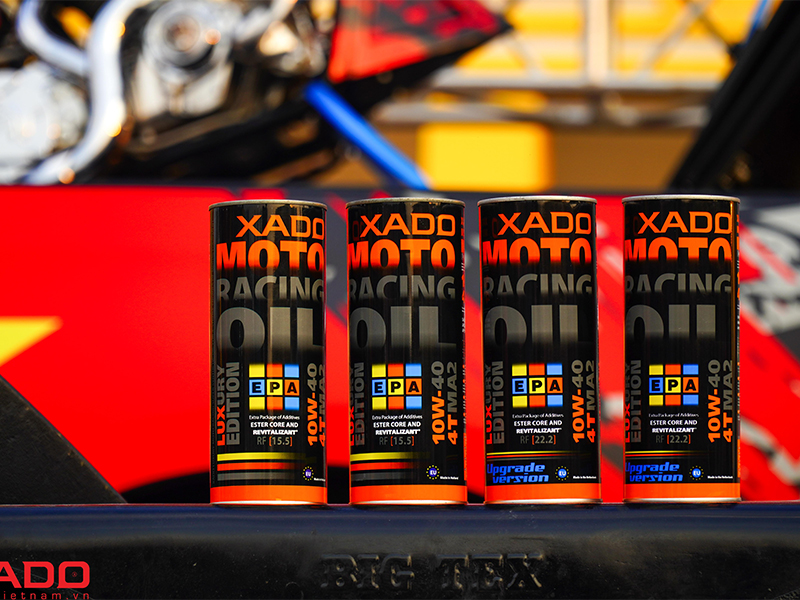
Once you understand how API, JASO, and SAE work together, the codes on the bottle stop looking like random letters and start telling a clear story. API points you to the quality level and engine type, JASO points you to the right friction profile for your bike or scooter, and SAE points you to the right viscosity for your climate. Read all three and you can choose with confidence instead of guessing.
We hope this guide makes your next oil purchase a little easier and helps you pick the best product for the vehicle you care about. And when you are ready to buy, drop by our store for genuine, quality-assured oil you can trust.
XADO VIETNAM
Address: 2nd Floor, VinFast Building – D1, 135–139 Dong Van Cong Street, Cat Lai Ward, Ho Chi Minh City
Website: www.xadovietnam.vn
Dealership inquiries: 028 77777 369
Email: kinhdoanh@songdailong.com






 About XADO