

 Tiếng Việt
 PRODUCT CATEGORIES
Looking after a scooter takes a bit of know-how, and that’s especially true when it comes to buying engine oil. Standing in front of a dozen bottles at the shop, each covered in numbers and codes, most riders end up asking the same thing: “What oil viscosity (W rating) is actually best for a scooter?”
Engine oil is often called the “blood” of the engine. It has a direct say in how durable your bike is, how responsive it feels, and how much fuel it burns. Picking the wrong viscosity doesn’t just make the bike feel sluggish and thirsty. It can seriously shorten the life of your engine. In this guide, we’ll walk you through everything you need to know, from start to finish, so you can choose the perfect viscosity (W) for your scooter.

1. What does the viscosity (W) rating on the bottle actually mean?
Before we answer which W rating is best for a scooter, it helps to understand what the symbol means. Any code containing the letter “W” on an oil bottle (for example 10W-30 or 5W-40) is part of the SAE standard, set by the Society of Automotive Engineers in the United States. It classifies the viscosity of the oil, in other words how thick or thin it is.
The rating usually has two parts:
- The number before the W (for example 5W, 10W): The W stands for Winter. This number describes how well the oil performs during a cold start. The lower the number, the thinner the oil is at low temperatures, which makes the bike easier to start early in the morning or in cold weather without straining or wearing down engine components.
- The number after the W (for example 30, 40, 50): This is the most important figure while the bike is running. It describes how thick or thin the oil stays when the engine is hot (usually measured at 100°C). A higher number means thicker oil and a heavier protective film. A lower number means thinner oil, which lets the engine run more smoothly, feel more responsive, and use less fuel.

2. What W rating is best for a scooter?
There’s no single “best” oil for every bike. There’s only the oil that suits your bike’s condition, your riding habits, and the weather you ride in. For scooters, manufacturers generally recommend the following viscosity grades: 10W-30, 10W-40, 5W-30, and 5W-40.
Here’s a closer look at each so you can decide for yourself.
2.1. 10W-30: The ideal choice for newer scooters and city riding
What it’s like: This is a fairly thin oil that strikes a great balance between easy starting and quick circulation up to the engine’s moving parts.
Best for: Most current Honda scooters (Air Blade, Vision, Vario, SH, Lead and so on) are recommended to run 10W-30 from the factory. It’s an excellent match for newer bikes (under 30,000km) and for riders with a gentle, around-town routine of short daily commutes.
The upside: The bike feels lively and responsive, jumps off the line when you twist the throttle, and delivers excellent fuel economy.
2.2. 10W-40: The perfect match for older bikes, heavy loads, and touring
What it’s like: 10W-40 has a thicker oil film than 10W-30. When the engine heats up, that film holds together rather than breaking down, sealing the gap between the piston and cylinder more effectively.
Best for: Yamaha and Piaggio/Vespa scooters are often recommended to run 10W-40. On top of that, if your scooter is getting on in age (over 30,000km) and the engine has started to rattle or sound rougher, or if you regularly ride long distances, go touring, or carry heavy loads, 10W-40 is the way to go.
The upside: Excellent engine protection at high temperatures, with a smoother, more solid feel and noticeably quieter running. The one small downside is that the bike can feel a touch sluggish first thing in the morning right after you start it.
What it’s like: Similar to 10W-30 in how thin it runs once the engine is up to temperature, but 5W-30 offers even better cold-start performance thanks to its lower first number (5W). The oil stays fluid even before the engine has warmed up.
Best for: Riders of newer scooters who love a light, effortless throttle and near-silent running. It’s a great fit for stop-and-go city traffic where you’re constantly starting and stopping the engine.
The upside: Optimized fuel efficiency and minimal friction from the very second you hit the starter button.
2.4. 5W-40: All-Round protection in tough conditions
What it’s like: This grade is typically reserved for the most premium fully synthetic oils. It makes for easy morning starts (5W) while holding its thickness and a tough protective film at high speeds or in hot weather (40).
Best for: Larger-displacement scooters (SH350i, Vespa GTS 300 and similar), as well as customized or tuned machines. It’s a great match for riders with a sporty style who like to open up the throttle hard.
The upside: Reliable performance in any weather and at any engine temperature, with strong protection against sludge and near-total engine protection overall.

3. The detail you can’t skip: The JASO MB mark for scooter oil
A lot of people assume that getting the W rating right is all there is to it. But the single biggest mistake (the one that leaves scooters running hot, noisy, and thirsty) is pouring oil meant for a manual or semi-automatic bike into a scooter.
To avoid this, you only need to look for one mark on the bottle: JASO MB.
What is the JASO standard?
JASO stands for the Japanese Automotive Standards Organization. It sets strict oil standards specifically for 4-stroke motorcycle engines, divided into several grades: MA, MA1, MA2, and MB.
JASO MA, MA1, MA2: These oils are for manual and semi-automatic motorcycles. Those bikes use a wet clutch, where the clutch assembly sits bathed in the oil. If the oil is too slippery, the clutch slips and the bike won’t pull properly. For that reason, MA/MA2 oils contain friction-boosting additives.
JASO MB: This is the standard reserved exclusively for scooters. Unlike manual bikes, scooters use a continuously variable transmission and a dry clutch (the clutch assembly sits separately and isn’t soaked in oil). The oil’s only job here is to lubricate the engine. So JASO MB oils are loaded with friction-reducing additives, helping the engine make the most of its power, burn less fuel, and cool down quickly.
The key takeaway: When you buy or change your oil, always check the label. If you see JASO MB, you can be completely confident the oil was made for your scooter. You can use scooter oil (MB) in things like tillers and generators, but you must NEVER pour scooter oil (MB) into a manual or semi-automatic bike, as it will cause the clutch to slip immediately. The reverse is also a problem: putting manual-bike oil (MA) into a scooter leaves it sluggish, running hot, and burning more fuel than usual.
4. Other factors worth watching for a long-lasting engine
Beyond the W rating and the JASO MB standard, becoming a savvy buyer means paying attention to two more things.
Base oil
There are three main types of base oil on the market today:
Mineral: The cheapest option, refined from crude oil. It handles heat poorly and loses its viscosity quickly, so it usually needs changing after 1,000-1,500km.
Semi-Synthetic: A blend of mineral and synthetic oil. The quality is quite good, the price is mid-range, and it suits the vast majority of riders. Change intervals run around 1,500-2,000km.
Fully Synthetic: The most premium type, engineered entirely in the lab. Its uniform molecular structure delivers excellent lubrication while cooling and cleaning the engine. The price is higher, but it lasts up to 2,500-3,000km, which works out very economical over the long run.
API quality grade
API stands for the American Petroleum Institute. For petrol engines (marked with the letter S), quality grades run alphabetically from SA, SB and so on up to SN and SP. The further down the alphabet, the higher the oil’s quality.
These days, when choosing scooter oil, it’s best to favor oils that meet API SN or API SP, so your engine benefits from the most advanced additive technology available.
5. Summary: How to choose scooter oil the right way
To put the question “What W rating is best for a scooter?” to rest for good, just remember this golden formula:
Honda, newer bikes, gentle city riding: Go with 10W-30 or 5W-30.
Yamaha/Piaggio, older bikes, long distances, heavy loads: Go with 10W-40 or 5W-40.
Non-negotiable: It must carry the JASO MB mark.
Recommended: If your budget allows, invest in a fully synthetic oil meeting API SN/SP.
One more maintenance tip: Don’t forget to change your oil on the recommended schedule. Beyond engine oil, scooters use another vital fluid: gear oil (transmission oil). The easiest rule to remember is to change the gear oil once for every three engine oil changes. This keeps the rear gear set running smoothly and prevents that rattling, clunking noise from the transmission.
6. The right oil protects your engine the moment it starts
Starting your bike correctly helps limit wear at startup, but choosing the right high-quality oil plays just as big a role in protecting the engine across every riding condition.
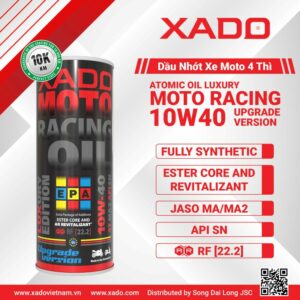
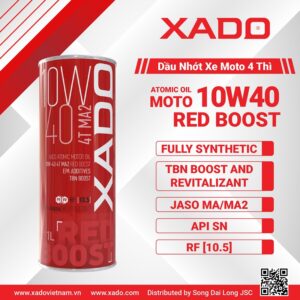
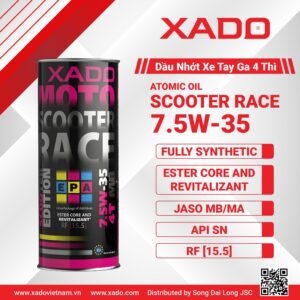
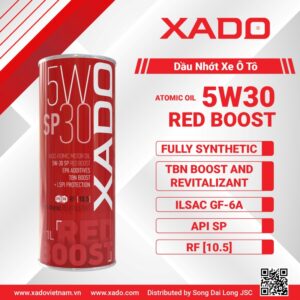
XADO is a well-known European brand recognized for its Atomic Revitalizant technology, which helps repair scratches and wear on metal surfaces while strengthening protection and extending engine life.
A few standout oils from XADO:
We hope this detailed guide has given you everything you need to feel confident the next time you’re choosing oil for your scooter. Here’s to a bike that stays durable and runs smoothly on every road ahead!
Which scooter are you riding right now, and what does your daily routine look like? Share with us and we’ll give you more specific advice.
XADO VIETNAM
Address: 2nd Floor, VinFast Building – D1, 135–139 Dong Van Cong Street, Cat Lai Ward, Ho Chi Minh City
Website: www.xadovietnam.vn
Dealership inquiries: 028 77777 369
Email: kinhdoanh@songdailong.com






 About XADO