

 Tiếng Việt
 PRODUCT CATEGORIES
Engine oil does a lot of quiet, thankless work. It lubricates, cools, and protects the moving parts inside your engine. But oil doesn’t last forever. Over time it breaks down, loses its lubricating power, and stops doing its job, which is exactly why it has to be replaced on schedule.
Plenty of drivers, especially first-time car owners, are still unsure about one basic question: how often to change car oil, and whether they should go by mileage or by time. Change it too early and you’re wasting money. Leave it too long and you’re looking at faster engine wear, higher fuel consumption, and in the worst cases, serious damage.
In this guide, XADO breaks it all down: how often you really need to change your oil, the warning signs that it’s overdue, and how to pick the right oil for your car.

What engine oil actually does
Engine oil is a blend of base oil and additives, and it plays a central role in how your engine runs. It’s one of the biggest factors behind your engine’s durability, performance, and fuel economy. Here’s what it’s doing under the hood:
Lubricating moving parts. Oil forms a thin film between the metal surfaces inside your engine, cutting down friction as everything moves. That keeps parts like the pistons, camshaft, and crankshaft running smoothly and minimizes wear.
Cooling the engine. Burning fuel generates a tremendous amount of heat. Oil absorbs and spreads that heat out, helping the engine hold a steady temperature and avoid the overheating that damages internal components.
Preventing rust and corrosion. That thin oil film on metal surfaces also blocks oxidation, shielding the engine from corrosive agents like moisture and the acids produced during combustion.
Keeping the engine clean. Oil picks up the dirt and carbon deposits created in the combustion chamber and carries them off to the oil filter. The result is a cleaner engine that stays reliable over the long haul.
Sealing the combustion chamber. Oil fills the tiny gaps between the pistons and cylinder walls, improving the seal. That helps maintain compression, which protects your engine’s power output and keeps fuel use in check.
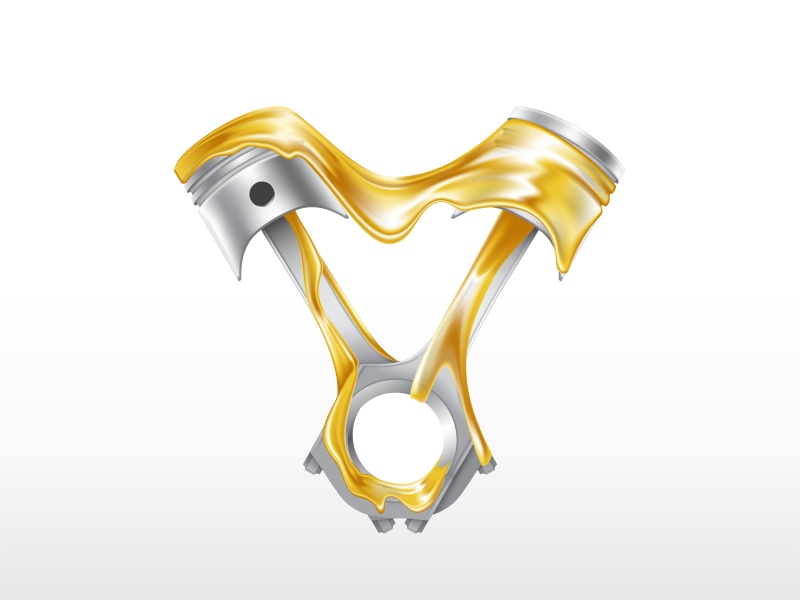
So, how often should you change your car oil?
This is the question almost every driver asks, and the honest answer is: it depends. Your oil change interval comes down to your vehicle, the type of oil you use, your driving conditions, and your habits behind the wheel.
For a brand-new car, the first oil change is usually recommended at around 600 to 1,900 miles (roughly 1,000–3,000 km). During break-in, the engine’s parts are still new and create more friction, which sheds tiny metal particles into the oil. Changing it early flushes those out and protects the engine.
After that first change, the typical intervals are:
- Conventional (mineral) oil: every 3,000 miles (about 5,000 km)
- Semi-synthetic oil: roughly every 4,500 to 6,000 miles (7,000–10,000 km)
- Full synthetic oil: up to 7,500 miles (12,000 km), and sometimes as far as 10,000 miles (16,000 km) for premium grades
A good rule of thumb for the oil filter: replace it every other oil change, or change the oil and filter together every 6,000 miles (10,000 km).
One caveat from the experts: if you regularly drive in tough conditions, think stop-and-go traffic, long jams, dusty roads, or sustained hot weather, you should shorten those intervals to keep your engine in top shape.
Warning signs your car needs an oil change
Mileage isn’t the only thing to watch. Keep an eye out for these red flags so you can change the oil before any real damage sets in.
The oil warning light comes on
This is the most obvious sign, and the one drivers ignore most often. When that light glows on the dashboard, it usually means oil pressure has dropped or the oil is too dirty to lubricate the engine properly.
The engine gets loud
Old oil loses the viscosity it needs to do its job, so metal parts rub together more and create extra noise. If you start hearing unusual knocking or droning, it may be time for a change.
The oil turns dark and gritty
Fresh oil is a clear amber color, but it darkens over time as it collects dirt and carbon deposits. Pull the dipstick and check, if the oil looks filthy, it’s due for a swap.
Fuel economy drops
Worn-out oil forces the engine to work harder, which burns more fuel. If your tank is emptying faster than usual for no clear reason, your oil is worth checking.
A burnt smell from the engine bay
When old oil breaks down under high heat, it can give off a burning odor. That’s a dangerous sign that the oil can no longer protect your engine and overheating may be setting in.
Black or bluish exhaust smoke
If your tailpipe is puffing out black or blue smoke, oil may be burning in the combustion chamber, either from a leak or because the oil is simply too old. Check it and change it right away before the problem gets worse.
What happens if you skip oil changes
Forgetting to change your oil on schedule doesn’t just hurt performance, it sets off a chain of problems for your car:
Weaker lubrication and a sluggish engine. As oil ages, its viscosity drops, and so does its ability to reduce friction between moving parts. The engine starts to feel heavy and runs louder.
Built-up sludge and contaminants. Dirt and impurities keep accumulating in the oil. Eventually the filter clogs, dirty oil bypasses it through the relief valve, and overall lubrication takes a serious hit.
Spent additives and faster wear. The additives that fight oxidation and wear eventually run out. Once they do, the engine wears down quickly and loses noticeable power.
More harmful emissions. The older the oil, the more readily it burns and releases harmful exhaust. Staying on schedule cuts those emissions down considerably.
Higher fuel consumption. When oil quality slips, the engine has to work harder to keep its power up, and your fuel bills climb as a result.
Major engine damage. Let this go long enough and critical parts like the pistons, cylinders, and crankshaft can suffer heavy damage. At that point, repairs cost many times more than a routine oil change ever would.
How to choose the right oil for your car
Start with the owner’s manual
The first thing to do is open the owner’s manual that came with your car and find the recommended oil for your specific model. Under normal driving conditions, the oils listed by the manufacturer are always the safest bet.
Look for API and SAE ratings
Every bottle of oil carries certification labels, and the two most important are API and SAE.
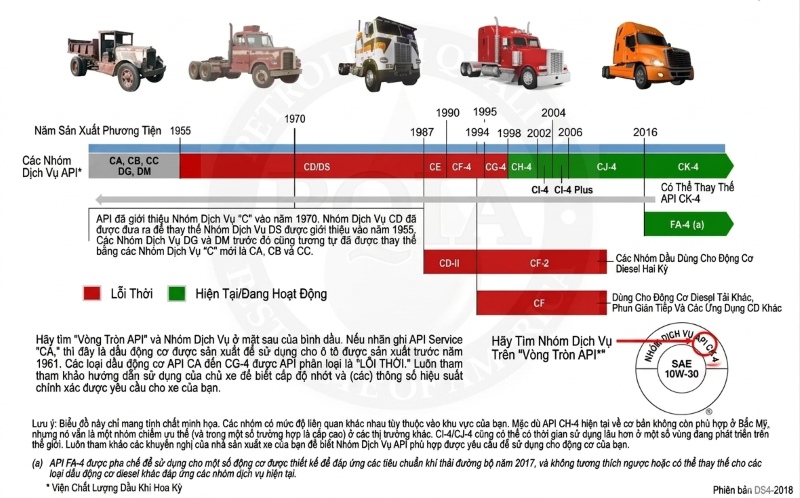
The API standard is set by the American Petroleum Institute and shown as a two-letter code on the bottle. A code starting with “S” is for gasoline engines, while “C” is for diesel. For modern gasoline engines, look for advanced grades like SN, SP, or the newest, API SQ. Diesel engines run from API CA up to the current top tiers, CK-4 and FA-4. As a general rule, the further the last letter falls in the alphabet, the higher the quality grade.
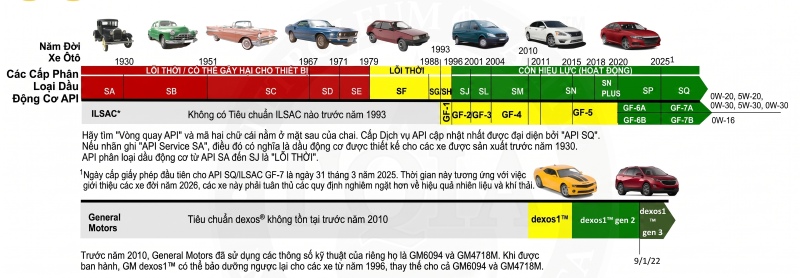
The SAE standard classifies oil by viscosity, like 5W-30, 10W-40, or 20W-50. The smaller the number before the “W” (for Winter), the thinner the oil and the better it flows on a cold start. The larger the number after the W, the better it lubricates at high temperatures. In a hot climate, the number after the “W” is the one to pay closest attention to.
Check the ILSAC standard too
Beyond API and SAE, it’s worth knowing about ILSAC, short for the International Lubricant Standardization and Approval Committee. This standard was developed jointly by American and Japanese automakers and applies mainly to the gasoline engines in brands like Toyota, Honda, Mazda, Ford, and Hyundai.
ILSAC ratings start with “GF” and have evolved through several generations, GF-5, GF-6A, GF-6B, with GF-7 being the newest grade today. Compared to API, ILSAC sets a higher bar for fuel economy, emissions-system protection, and resistance to LSPI (low-speed pre-ignition) in direct-injection engines (GDI/TGDI). If you drive a mainstream car from Japan, Korea, or the US, oil meeting ILSAC GF-5, GF-6, or GF-7 is your best choice.
ACEA standards for European cars
ACEA stands for the Association des Constructeurs Européens d’Automobiles (the European Automobile Manufacturers’ Association). It’s a separate standard system for oils used in Europe, and its tests are considered tougher than API in certain areas, especially high-temperature resistance and protecting engines that run continuously at high speeds.
ACEA breaks down into three main groups: the A/B group for light-duty gasoline and diesel engines (such as A3/B4, A5/B5); the C group for engines with modern emissions systems like DPFs and three-way catalysts (C2, C3, C4, C5); and the E group for heavy-duty diesel engines. If you own a European car, BMW, Mercedes-Benz, Audi, Volkswagen, Volvo, choosing oil that meets both API and ACEA is essential, since many newer models require a specific ACEA grade along with the manufacturer’s own approval.

Match the right viscosity
Thicker oil lubricates better, but if it’s too thick it struggles to reach every nook of the engine. Oil that’s too thin, on the other hand, degrades quickly, especially when the engine runs hot. The right viscosity depends on your manufacturer’s recommendation and the climate where you live.
Know your three main oil types
There are three common types of engine oil on the market today. Conventional (mineral) oil is the cheapest and works fine for everyday cars, but it needs changing more often. Semi-synthetic oil offers better protection and wear resistance, and it’s currently the most popular choice. Full synthetic oil is engineered for high-tech engines, stays stable in both cold and hot conditions, and lasts the longest, though it costs noticeably more.
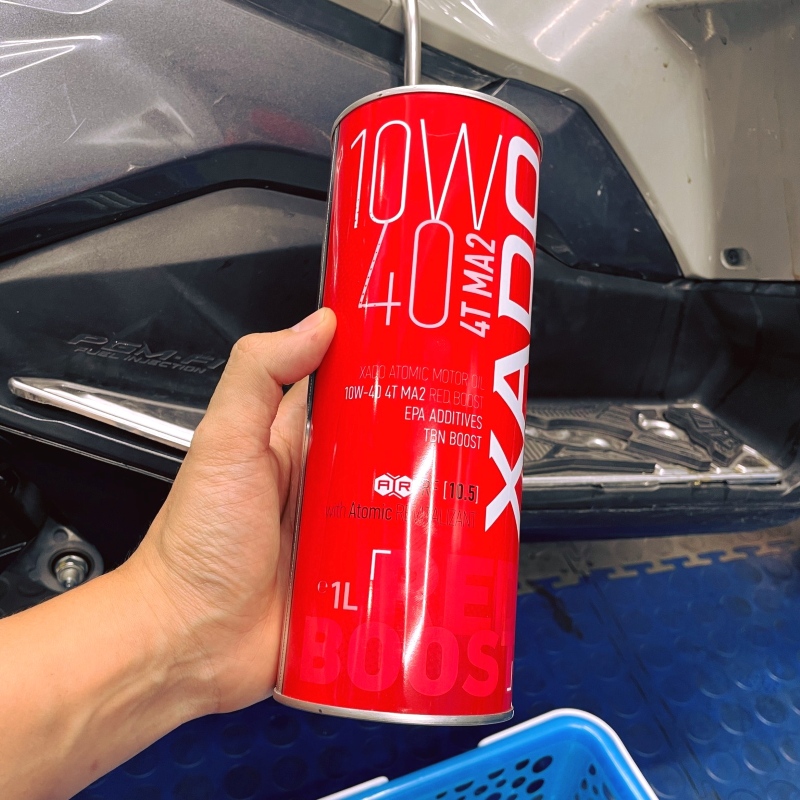
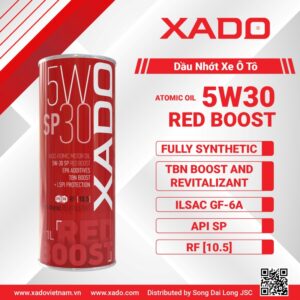
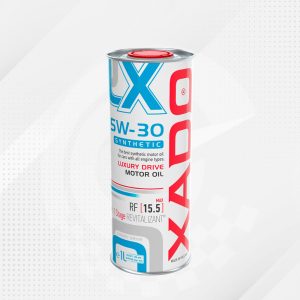
A few premium XADO car oils worth a look:
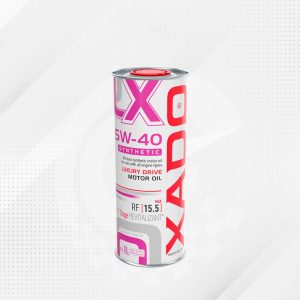
The Bottom Line
Knowing how often to change car oil, and how to choose the right oil, puts you in control of your maintenance, your engine’s performance, and its lifespan. Make a habit of checking your oil regularly, and your car will keep running at its best.
XADO Việt Nam
Địa chỉ: Lầu 2 Tòa nhà VinFast D1, 135 – 139 Đồng Văn Cống, Phường Cát Lái, TP Hồ Chí Minh
Website: www.xadovietnam.vn
Liên hệ làm đại lý: 028 77777 369
Email: kinhdoanh@songdailong.com





 About XADO